
It’s Friday night and a familiar figure is on stage at 100 Club, underneath London’s Oxford Street. She’s got the beehive hairdo, the tattoos, the lip piercing, that soul-rumbling snarl. But this isn’t Amy Winehouse; it’s Caroline Lowe, a tribute act performing with her band, the Amy Winehouse Experience.
Lowe has been impersonating Winehouse for nearly 20 years, since before the singer passed away in 2011 of alcohol poisoning. Watching her onstage is almost unsettling, like stepping into an alternate universe in which Winehouse survived. There’s also something magical about it: some of the audience, too young to remember the real Winehouse, dance ecstatically to Lowe’s rendition of “Rehab”.
When I meet her backstage, Lowe explains how the tribute band, often dismissed as naff and gimmicky, managed to carve out a cooler reputation. “People saw it as a bit of band karaoke,” she says, in a northern accent that comes as a surprise (she channels Winehouse’s Estuary vowels during the show). “Then everyone realised over time that, actually, original bands will only ride to their ability. If you are copying someone like Slash, you’ve got to be really good musicians.”
It’s an opinion the tribute community seems to share. Chris Neale, who plays Johnny Marr in the Smiths Utd, says cover bands prop up the live music scene. “If you look at a lot of our gigs, they might be in Heaton Park, where Oasis did their big gig. We play a club in Preston called the Continental every year – completely sold out for 350 people.” At the end of February, the Smiths Utd headlined the O2 Academy Islington, and later this year the venue is hosting Fleetwood Bac, Deeper Purple and Definitely Oasis.

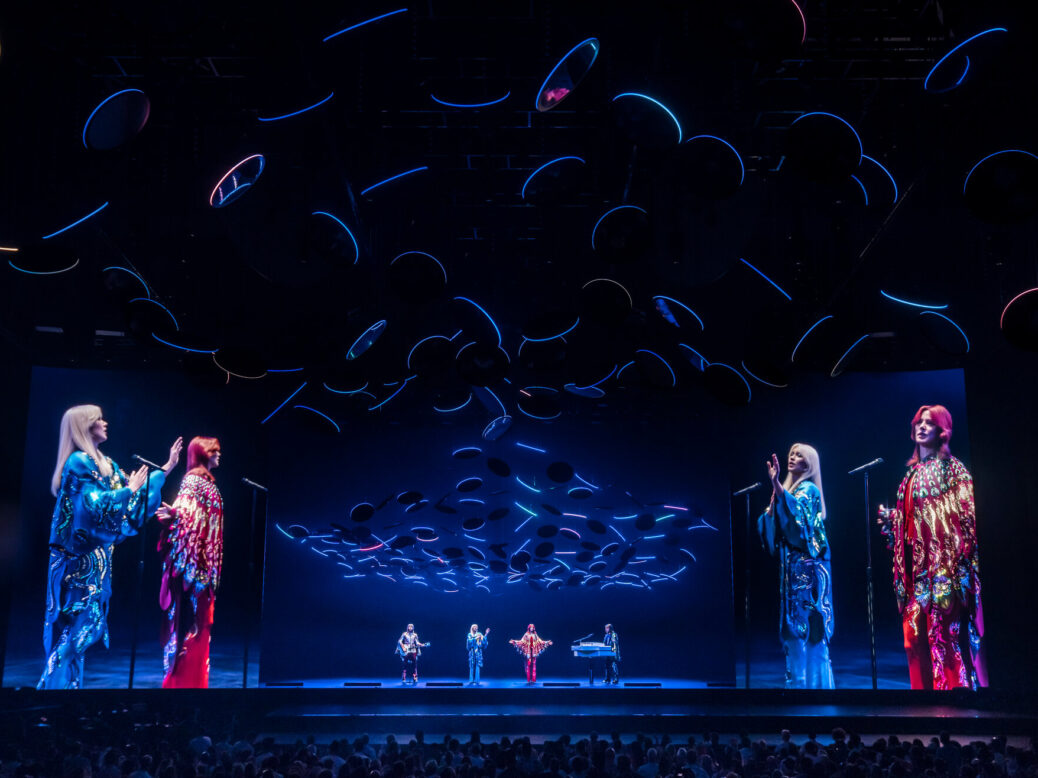
Alongside the tribute boom, there’s a growing interest in hologram concerts. Abba Voyage, a virtual show in east London, has had over three million visitors since it opened in 2022. The show is performed by avatars, or Abba-tars in this case. This digital tribute act was difficult to create: the band had to perform in motion capture suits for five weeks as 160 cameras scanned their bodies. The footage was then used as a reference point for hundreds of animators and visual effects artists.
But as AI improves, hologram concerts will become quicker and easier to produce. Phil Copping, a seasoned Freddie Mercury impersonator, tells me he’s been working as a body double for a virtual Queen experience. “It uses the next stage of technology from what Abba has done,” he explains. “It’s my body, my movement, but with an AI face swap, that has been refined over the course of the year. I mean, it’s absolutely phenomenal what they’ve managed to do.” I ask him whether tribute bands like his own, Supersonic Queen, could be squeezed out. “ I think it’s a different entity,” he says. “I’ve seen the Abba show and I was blown away with how good it was, but it’s a different experience.”
Queen’s guitarist Brian May hinted at plans for a virtual concert last year. He told the Big Issue: “Freddie is still alive through the music that we listen to all the time… things that are immersive, like The Sphere in Las Vegas… that really appeals to me.” It’s not just Queen: accounts filed by George Michael’s company suggest his estate has plans to launch such live events in future, and a world tour featuring a hologram of the late Punjabi star Sidhu Moose Wala is slated for later this year.
Hologram concerts have been a moral minefield since a virtual version of Tupac appeared at Coachella in 2012. Catherine Allen, CEO at Limina Immersive, a research organisation specialising in immersive media, says bringing back deceased artists raises important questions. “Where does the money go? Does it go to their estate? If there’s no consent, then this could just create some wild west situation.”
For Tupac’s Coachella performance, consent was given by the executors of his estate, which is controlled by his mother. But consent can be withdrawn, meaning projects can collapse at the last minute. When footage of a Whitney Houston hologram performance on the Voice was leaked online, the singer’s estate decided to cancel its official unveiling. And even if consent is granted, controversy can stop a project getting off the ground. A hologram show of Winehouse was announced back in 2018, but stalled due to “some unique challenges and sensitivities.” Winehouse’s family were accused of “cashing in” on the singer’s legacy.
Allen argues that even with consent, things could go wrong. “You can imagine it going in a dystopian direction where maybe an artist had signed up for one thing before they died, but then it goes in a direction they wouldn’t have been happy with. Adult content is on the extreme end, but it’s also worth considering suggestive dances. We’ve seen with Grok, it’s the way things go.” (Grok, a generative chatbot developed by Elon Musk’s company, created sexualised AI deepfakes of real people, including children.)
Since 2023, Generative AI tools have exploded in popularity. On TikTok, you’ll now find videos of Freddie Mercury singing “I Set Fire to the Rain” by Adele or Amy Winehouse covering “Flowers” by Miley Cyrus (both songs came out after their deaths). Last month, Sony Music requested the removal of more than 135,000 deep-fake songs impersonating its artists on streaming services. High-profile musicians including Billie Eilish, Nicki Minaj and Stevie Wonder have called for protections against the use of AI that mimics human artists’ likenesses and sound.
In an age where imitating artists has never been easier, the role of the tribute act could be called into question. But, as Generative AI becomes more sophisticated and musical deep fakes proliferate, our appetite for cover bands continues to increase. There are now over 30 tribute festivals in the UK – including Tribfest, the Big Fake and Glastonbudget – and ticket sales are on the rise. GlastonBarry, a local festival in Wales, which started in 2013 with only 500 people, welcomed an audience of 18,000 last year.
At the 100 Club, I ask Lowe whether she’s worried about her Winehouse tribute act being replaced by AI. She ponders, picking at a remarkably convincing transfer tattoo. “I think there might be a period where people get very excited about it,” she says. “But ultimately they’ll come back. They’ll come back because it’s not real.”
[Further reading: Chile’s melodies of survival]
Content from our partners


Related


Join the debate
Subscribe here to comment